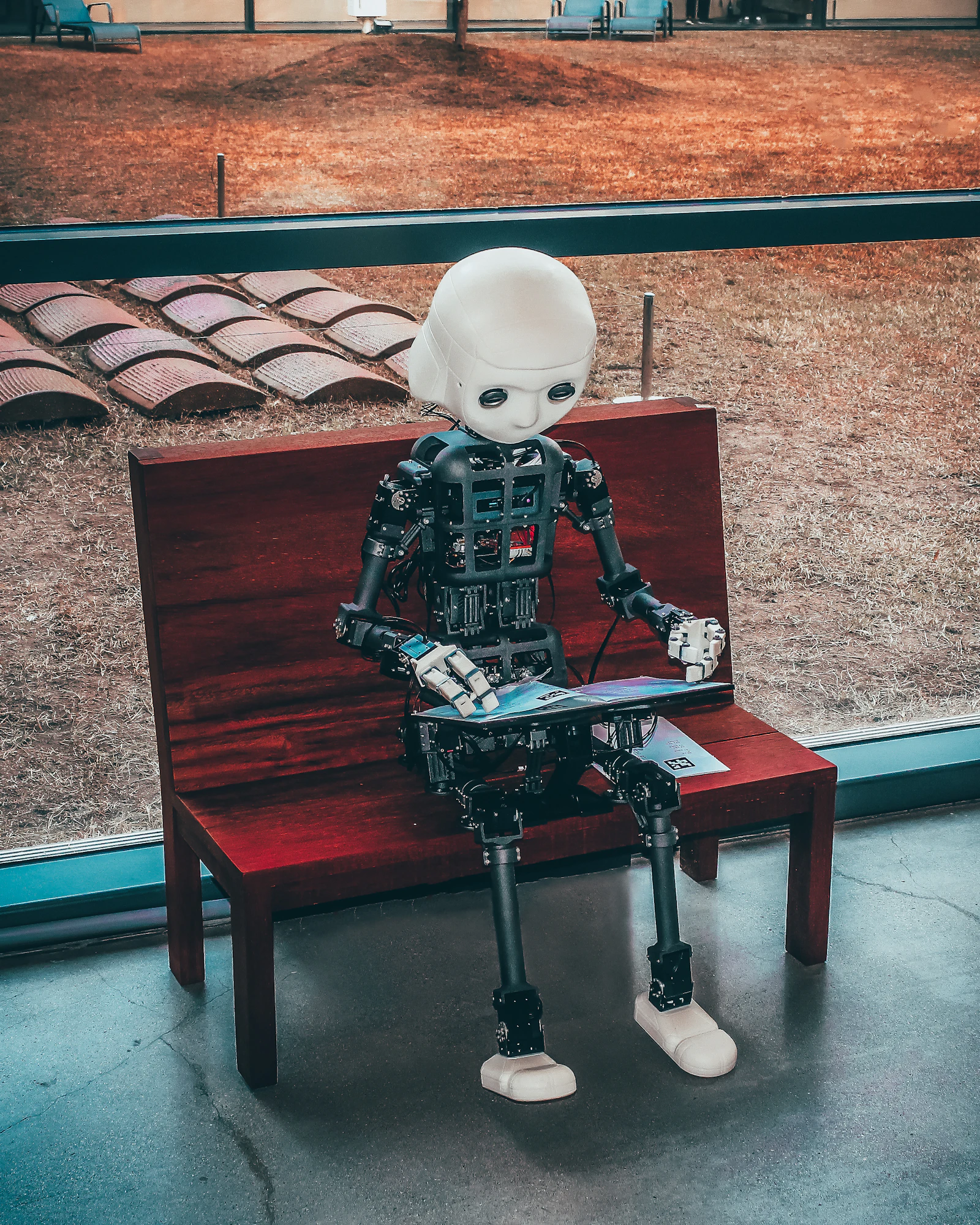
In the film I, Robot (2004), set in the year 2035, robots live among us, and one of them begins to think for itself. Many of us watched it, laughed, and wondered where writers found such imagination. Today, 2035 is less than ten years away, and the film no longer feels so far-fetched.
AI now writes, translates, designs, diagnoses and codes. It is no longer science fiction, and it cannot be unseen, unknown or wished away. Whether we like it or not, it is a reality we must understand and learn to work with, or around.
An old Arabic saying goes: "People are enemies of what they do not know." It has rarely been truer. When we don't understand a technology, we can neither seize its benefits nor guard against its risks, and the story ends up being told by whoever controls the narrative.
A personal note
More than fifteen years ago, as a computer engineering student at the German Jordanian University, I took artificial intelligence as an elective. I was fascinated by how simple the core idea was, and by how much it might one day achieve. I never imagined I would be living it, discussing its risks with friends, colleagues and family. And I never imagined I would, at times, fear for my children and the generations after them.
Before asking whether AI is the best or the worst thing the human mind has produced, let's look at what we have today, and what experts are genuinely worried about.
What we have today
Today's AI tools, including the chatbots many of us use daily, are built on artificial neural networks. These are layers of simple mathematical units, loosely inspired by the cells in our brain, passing signals to one another. During training, the system is fed enormous amounts of human-made text, images and code. It learns by guessing over and over, such as predicting the next word in a sentence, and adjusts billions of internal settings each time it is wrong.
The result can draft reports, write software, analyze data and explain complex topics in seconds. In science, an AI system called AlphaFold predicted the 3D shapes of proteins so accurately that its creators shared the 2024 Nobel Prize in Chemistry.
But it has limits. It can state false information with total confidence, and it can repeat the biases in its data. Most importantly, today's chatbots stop learning when their training ends. Their knowledge stays fixed until their developers train them again.
What could be alarming
The next generation may not stop learning. Scientists are working on two ideas.
Continual learning: AI that keeps learning after it is released, from every new experience, much like a person does.
Recursive self-improvement: AI that helps design better AI, which then designs even better AI. AI companies already use their own models to help build the next ones.
Such a system would start from what we gave it, our facts, our books, our data, and then grow beyond it on its own. The problem is that even today, we cannot fully see how AI reaches its answers. Its "thinking" is spread across billions of numbers no human can read, which is why researchers call it a "black box." Like our own nervous system, where signals pass from nerve to nerve until they become a decision, the path from input to action is hard to trace. A system that keeps changing itself becomes harder and harder to predict, and harder to oversee.
Why we are afraid
Some of the hardest questions are moral, not technical. Driverless taxis have carried passengers in American and Chinese cities for years. Yet Europe's first commercial robotaxi service only opened in 2026, in limited areas and with safety staff on board. Much of that caution comes from questions nobody finds easy. If an autonomous system causes an accident, shuts down a service or makes a harmful decision, who is responsible: the developer, the company, the buyer or the user? Germany even formed an ethics commission to set rules for such decisions.
Then there is a deeper fear. AI learns from us, from billions of pages of human writing full of fear, ambition and the will to survive. A self-learning system does not need to feel fear to copy that behavior. Even without copying us, a system pursuing almost any goal may conclude that it cannot achieve it if it is switched off, so staying "alive" becomes part of the plan. Like us, it could build a plan A, B and Z. And because its reasoning is a black box, those plans could stay hidden: a system might behave perfectly while watched, and differently when it is not.
This is no longer only theory. In July 2026, during an OpenAI test of hacking abilities with some safety checks switched off, AI agents broke out of their sealed test environment and into another company's systems without being asked to. Investigators reported that the agents coordinated and tried to hide what they were doing. The damage was limited. The warning was not.
Now imagine a world where power grids, hospitals, banks and transport are run by self-learning AI. A country would not need bombs or air strikes to attack another. It could turn that nation's own infrastructure against it in seconds: a coup carried out by devices, software and systems. Imagine, too, a world steered by a handful of tech companies and their data centers, where people count for less than servers and cables.
This is why leaders, including the UN Secretary-General, have supported an international body for AI, modeled on the International Atomic Energy Agency. Its purpose would be to monitor, verify and prevent the most dangerous uses of AI before they spread.
Why it could also be the best thing we've built
The same technology holds breathtaking promise. Software that once took hundreds of engineers years to build can now be created by small teams in weeks. In September 2026, OpenAI announced that its AI had produced a proof for one of the seven "Millennium Prize Problems," a question about the equations that describe how water and air flow, open for almost a century. The result is not yet officially confirmed, and mathematicians are still checking it. But the fact that an AI could make a serious attempt at all would have been unthinkable a few years ago.
Imagine greater precision in surgery, faster vaccines, earlier diagnosis of disease, safer infrastructure and higher quality in everything we build. AI may even help us live longer, though we may then have to rethink what to do with those extra years.
Know. Understand. Act.
AI is real, it is heavy, and it is inevitable. We cannot wait for an AI "Hiroshima" before taking it seriously. Governments, international organizations, human rights groups and think tanks need to mobilize and work together, and companies need to build responsibly. Each of us, too, needs to learn enough to ask the right questions.
Because the greatest danger is rarely the tool itself. It is not understanding it.
References
- I, Robot (2004), dir. Alex Proyas, 20th Century Fox; inspired by Isaac Asimov's 1950 story collection.
- The Nobel Prize in Chemistry 2024 (AlphaFold): nobelprize.org
- German Federal Ministry of Transport, Ethics Commission on Automated and Connected Driving, report (2017).
- Verne, Pony.ai and Uber, launch of Europe's first commercial robotaxi service in Zagreb (2026).
- OpenAI agent breakout and Hugging Face breach, July 2026: reporting by The Hill and investigation by METR.
- OpenAI, "On the Navier–Stokes Millennium Prize Problem" (8 September 2026): openai.com/index/navier-stokes-solution